The Norse Gods

Featured

The Norse Gods are the mythological characters that, as far as we know, came from the Northern Germanic tribes of the 9th century AD. These stories were passed down in the form of poetry until the 11th – 18th centuries when the Eddas and other medieval texts were written.

Norse mythology comprises the pre-Christian beliefs and legends of the Scandinavian peoples including those who settled on Iceland where most of the written sources for Norse mythology were assembled. Norse mythology not only has it’s gods, goddesses and immortals but also a myriad of other characters and creatures that populate the stories including giants, dwarfs, monsters, magical animals and objects.

A List of The Norse Gods

  • Aegir – Norse God of the sea. Married to Ran and lives under the waves near the island of Hlesey.
  • Aesir – A group of warrior gods led by Odin who inhabit Asgard.
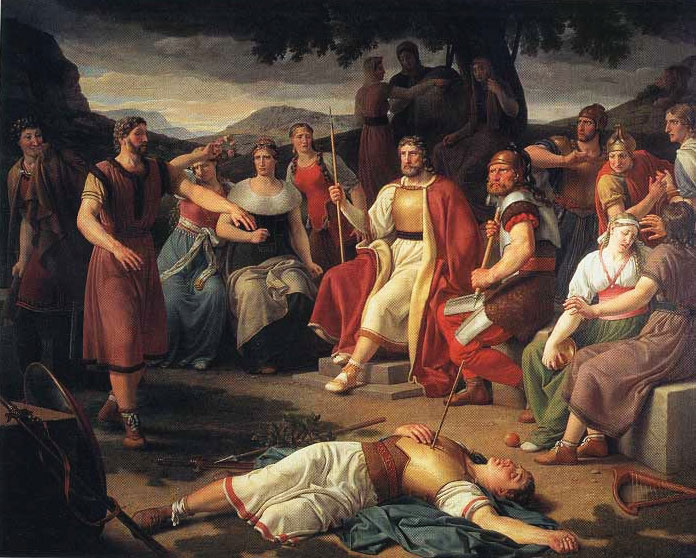
  • Balder – Son of Odin and Frigg. Known as a gentle and wise god. Killed accidentally by his brother Hod. Will return after Ragnarok.
  • Bolverk – The alias Odin adopted when disguised as a giant to win the mead of poetry.
  • Bor – Son of Buri and father of Odin, Vili and Ve.
  • Bragi – The Norse God of poetry and eloquence. Son of Odin and husband of Idun.
  • Buri – Ancestor of the Norse gods. Created by the cow Audmula licking him from ice.
  • Day – Son of Night and Delling. Said to ride around the earth on his horse Skinfaxi.
  • Earth – Daughter of Night and Annar.
  • Einherjar – Band of dead warriors in Valhalla who await Ragnarok.
  • Eir – Goddess of healing
  • Fjorgyn – Lover of Odin and mother of Thor. Also referred to as Earth.
  • Forseti – God of Justice. Son of Balder and Nanna.
  • Freyja – Main goddess of the Vanir (fertility gods). Daughter of Njord and sister of Freyr.
  • Freyr – Important god of the Vanir. Son of Njord and brother of Freyja.
  • Frigga – Main goddess. Wife of Odin and mother of Balder.
  • Fulla – Goddess servant of Frigga.
  • Gangnrad – Pseudonym of Odin when he visits Vafthrudnir.
  • Gefion – Fertility goddess. Associated with the plow. Tricked the king of Sweden out of a tract of his land.
  • Grimnir – Pseudonym of Odin when he visits his foster son Geirrod, King of the Goths.
  • Gullveig – A Vanir goddess (probably Freyja) who is burned three times by the Aesir.
  • Harbard – Odin disguised as a ferryman when he wrangles with Thor.
  • Heimdall – Watchman of the Norse gods and owner of the horn Gjall. Son of nine mothers. Often identified with Rig, the creator of three races of men.
  • Hel – ruler of Helheim, the realm of the dead
  • Hermod – Son of Odin. Rode to Hel to try and rescue his brother Balder.
  • Hod – Son of Odin. A blind god who accidentally killed his brother Balder. he will return after Ragnarok.
  • Honir – A long-legged, indecisive god. Sent to the Vanir to seal the truce between them and the Aesir. He will survive Ragnarok.
  • Idun – Guardian of the golden apples of youth and wife of Bragi.
  • Lofn – Goddess of ilicit unions.
  • Loki – The sly, trickster of the Norse gods. Son of two giants. Also known as the Sly One, the Trickster, the Shape Changer and the Sky Traveller. Becomes increasingly more evil. He is responsible for the death of Balder. Bound until Ragnarok.
  • Magni – Son of Thor and the giantess Jarnsaxa. Will inherit Thor’s hammer Mjollnir with his brother Modi after Ragnarok.
  • Mimir – Wise Aesir god. Sent to the Vanir to seal the truce between the two groups of the Norse gods. Killed by the Vanir, his head is kept by Odin.
  • Modgud – Maiden guardian of the bridge over the river Gjoll in Jotenheim.
  • Modi – Son of Thor and the giantess Jarnsaxa. Will inherit Thor’s hammer Mjollnir with his brother Magni after Ragnarok.
  • Moon – Son of Mundilfari. Guides the moon on it’s course.
  • Nanna – Wife of Balder and daughter of Nep.
  • Narvi – Also known as Nari. Son of Loki and Sigyn who was killed by his brother Vali.
  • Night – Daughter of Narvi and mother of Day. Rides around the earth on her horse Hrimfaxi.
  • Njord – A Vanir god associated with wind and sea. Husband of Skadi and father of Freyja and Freyr.
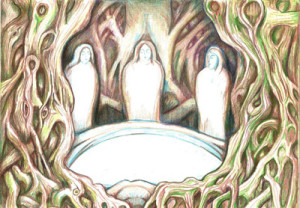
  • Norns – Urd “fate”, Skuld “being” and Verandi “necessity”. Three goddesses of destiny.
  • Od – Missing husband of Freyja who she constantly mourns for.
  • Odin – King of the Norse Gods, God of poetry, battle and death. Chief god of the Aesir. Also known as the “all-father”, the “terrible one”, “one-eyed” and “father of battle”.
  • Ran – Wife of Aegir who dragged drowning men down with her net.
  • Rig – Pseudonym of Heimdall and the creator of three races of men.
  • Rind – Goddess and lover of Odin. Mother of Vali.
  • Saga – Goddess and drinking companion of Odin.
  • Sif – Wife of Thor whose golden hair was cut off by Loki.
  • Sigyn – Wife of Loki.
  • Sjofn – Goddess of human passion.
  • Skadi – Goddess of Winter and of the Hunt
  • Sun – Daughter of Mundilfari and guide of the sun.
  • Syn – Goddess of the accused at trial.
  • Thor – God of Sky, thunder and fertility. Associated with law and order in Asgard and guardian of the Norse gods. Son of Odin and Earth and husband of Sif. Also known as the “thunder god” and “charioteer”.
  • Thrud – Daughter of Thor. Promised to the dwarf Alvis.
  • Tyr – War god. Son of Odin who sacrificed his hand in the binding of Fenrir.
  • Ull – God of archery and skiing.
  • Vali – Son of Odin and the giantess Rind. Conceived to avenge the death of Balder.
  • Valkyries – Beautiful women who carried dying warriors to Valhalla.
  • Vanir – Fertility gods.
  • Var – Goddess of marriage oaths.
  • Ve – Son of Bor and brother of Odin and Vili.
  • Vidar – Son of Odin and the giantess Grid who will avenge Odin’s death after Ragnarok.
  • Vili – Son of Bor and brother of Odin and Ve.
  • Vor – Goddess who knows all.

Mythological Realms of The Norse Gods

  • Alfheim – The land of the light elves in Asgard
  • Algron – Island where Odin (Harbard) stayed for five years
  • Asgard – Land of the Aesir
  • Bilskirnir – Thor’s hall in Asgard
  • Bifrost - The flaming rainbow bridge between Asgard and Midgard
  • Breidablik – Balder’s hall in Asgard
  • Elivagar – The eleven rivers that flow from the spring of Hvergelmir in Niflheim.
  • Eljudnir – Hel’s hall in Nifleheim
  • Fensalir – Frigg’s hall in Asgard
  • Folkvang – Site of Freyja’s hall in Asgard
  • Franang’s Falls – Waterfall in Midgard where Loki, disguised as a salmon, was caught by the gods.
  • Gimli – Hall of the gods after Ragnarok
  • Ginnungagap – The void between Muspell and Nifleheim before the creation.
  • Gladsheim – Sanctuary of the Norse gods on the plain of Ida.
  • Glitnir – Silver and gold hall of Forseti, son of Balder, in Asgard.
  • Gnipahellir – Cave in front of Niflheim where the hound Garm is chained up.
  • Helheim – The realm of the dead in Niflheim, ruled over by the monster Hel.
  • Himinbjorg – Heimdall’s hall in Asgard
  • Hlesey – Island near the undersea hall of Aegir and Ran.
  • Hlidskjalf – Odin’s high thrown in Valaskjalf.
  • Hnitbjorg – Stronghold of the giant Suttung.
  • Hvergelmir – Spring in Niflheim under the root of Yggdrasill.
  • Idavoll – The central plain of Asgard. Contains the halls of Gladsheim and Vingolf.
  • Iving – River dividing Asgard from Jotunheim
  • Jotunheim – Land of the giants
  • Lyfjaberg – Mountain beside Menglad’s hall in Jotunheim.
  • Lyngvi – Island on lake Armsvartnir where Fenrir is bound.
  • Lyr – Menglad’s hall in Jotunheim
  • Midgard – The realm of mankind.
  • Mimir’s Well – Well of wisdom under the root of Yggdrasill in Asgard which is guarded by the head of Mimir.
  • Muspell – Southern land of fire guarded by the giant Surt.
  • Nastrond – Site of the hall of evil-does in Hel. The dragon Nidhogg gnaws at corpses here.
  • Niflheim – Land of freezing mist and darkness and home of Hel.
  • Okolnir – Land of warmth created after Ragnarok. Site of the hall of Brimnir.
  • Sessrumnir – Freyja’s hall in Asgard.
  • Sindri – Red gold roofed hall which will appear after Ragnarok.
  • Sokkvabekk – Saga’s hall in Asgard
  • Svartalfheim – Realm of the dark elves.
  • Thrudheim – Thor’s realm in Asgard and site of his hall Bilskirnir.
  • Thrymheim – Stronghold of the giant Thiazi which was passed on to his daughter Skadi.
  • Utgard – Realm in Jotunheim ruled by Utgard-Loki.
  • Valaskjalf – Odin’s hall in Asgard.
  • Valhalla – Hall presided over by Odin where the Einherjar await Ragnarok.
  • Vanaheim – Land of the Vanir in Asgard.
  • Vigrid – Plain in Asgard where the final battle will occur.
  • Vingolf – Hall of the goddesses in Asgard.
  • Ydalir – Ull’s hall in Asgard.
  • Yggdrasill – The world tree (Hodmimir’s wood)

Many believe the Norse gods and the other mythological beings of ancient Scandanavia represent aspects of the self, our emotions and the many qualities that make up the psyche of the human self.

The Building of Asgard’s Wall – Myth 3

Long after the Golden Age, it was still very early in the cycle of time. And long after the war between the Aesir and the Vanir, the wall around Asgard that the Vanir had razed with their battle-magic remained a ring of rubble, deserted, the home of eagles and ravens.

The gods were anxious that the wall should be rebuilt, so that Asgard would be safe from evil-doers, but none were eager to take the heavy burden of rebuilding on their own shoulders. This is how matters stood for some time until, one day, a solitary figure on horseback cantered over the trembling rainbow, and was stopped by the watchman Heimdall. Continue reading

The War of the Aesir and Vanir -Myth 2

Odin did not extend a friendly welcome to the witch Gullveig when she came to visit him. In his hall the High One and many other Aesir listened with loathing as she talked of nothing but her love of gold, her lust of gold. They thought that the worlds would be better off without her and angrily seized and tortured her; they riddled her body with spears.

Then the Aesir hurled Gullveig on to the fire in the middle of the hall. She was burned to death; but out of the flames she stepped whole and reborn. Three times Aesir burned Gullveig’s body and three times she lived again. Continue reading

Myth 1 – The Creation

These tales have existed for thousands of years in the form of poems, songs and stories until put into written form in the early 11th century. Though several authors attempted to preserve them our “best” source is Snorri Sturluson’s Prose Edda. This is the creation story. The first of the 32+ Norse Myths. My main source is the “The Norse Myths” by Kevin Crossley-Holland.

Burning ice, biting flame; that is how life began. In the south is a realm call Muspell. That region flickers with dancing flames. It seethes and it shines.  No on can endure it except to those born into it. Black Surt is there; he sits on the furthest reach of that land, brandishing a flaming sword; he is already waiting for the end when he will rise and savage the gods and whelm the whole work with fire. Continue reading

The Nine Worlds of Norse mythology

  • The first level: Asgard, world of the Aesir; Vanaheim, land of the Vanir; and Alfheim, land of the light elves.
  • The second level: Midgard, Land of humans (middle world/garden); Nidavellir, Land of the dwarfs; Jotunheim, Land of the giants (Jotuns); and Svartalfheim, Land of the dark elves.
  • The third level: Hel, Realm of the dead; and Niflheim, World of the dead.

If Hel and Niflheim comprised one world, as is suggested in some sources, the ninth may have been Muspelheim (Muspell), the land of the fire giants. This region had no place in the tricentric structure of the universe, and Snorri Sturluson wrote that is was the first world to exist and that is lies in the southern hemisphere. Also, the worlds of Svartalfheim and Nidavellir may have been the same. No valid distinction can be drawn between the dwarfs and dark elves; they appear to have been interchangeable.

Norse Mythology: A Brief Synopsis

According to Norse mythology, the beginning of life was fire and ice, with the existence of only two worlds: Muspelheim and Niflheim. When the warm air of Muspelheim hit the cold ice of Niflheim, the jötunn Ymir and the icy cow Audhumla were created. Ymir’s foot bred a son and a man and a woman emerged from his armpits, making Ymir the progenitor of the Jotun. Whilst Ymir slept, the intense heat from Muspelheim made him sweat, and he sweated out Surtr, a jötunn of fire. Later Ymir woke and drank Audhumbla’s milk. Whilst he drank, the cow Audhumbla licked on a salt stone. On the first day after this a man’s hair appeared on the stone, on the second day a head and on the third day an entire man emerged from the stone. His name was Búri and with an unknown jötunn female he fathered Bor, the father of the three gods Odin, Vili and Ve. Continue reading