Norse Mythology – Creation of the World

Today we have the creationist, the Darwinist, the Atheists, and a handful of others. Each with their own stories and justifications. Me, I am a “have no ideaist” but I am always open to suggestions. This one is pretty cool.

Tags: , ,

Norse Mythology – Creation of the Universe

Many things in our world remain unknown. As the human psyche constantly strives for resolution many of these unknowns find solace in the ancient traditions of mythology and metaphor. Even though science has answered many of our questions and has laid forth a path towards the resolve of many more, the stories of our ancestors can tell us much about ourselves, where we came from and perhaps where we are headed.

The beliefs we cling to today be they religious, scientific, or social will most likely seem primitive to our descendants and if so we could only hope they find them as freakin’ awesome and colorful as Norse Mythology.

The Norse Gods

The Norse Gods are the mythological characters that, as far as we know, came from the Northern Germanic tribes of the 9th century AD. These stories were passed down in the form of poetry until the 11th – 18th centuries when the Eddas and other medieval texts were written.

Norse mythology comprises the pre-Christian beliefs and legends of the Scandinavian peoples including those who settled on Iceland where most of the written sources for Norse mythology were assembled. Norse mythology not only has it’s gods, goddesses and immortals but also a myriad of other characters and creatures that populate the stories including giants, dwarfs, monsters, magical animals and objects.

A List of The Norse Gods

  • Aegir – Norse God of the sea. Married to Ran and lives under the waves near the island of Hlesey.
  • Aesir – A group of warrior gods led by Odin who inhabit Asgard.
  • Balder – Son of Odin and Frigg. Known as a gentle and wise god. Killed accidentally by his brother Hod. Will return after Ragnarok.
  • Bolverk – The alias Odin adopted when disguised as a giant to win the mead of poetry.
  • Bor – Son of Buri and father of Odin, Vili and Ve.
  • Bragi – The Norse God of poetry and eloquence. Son of Odin and husband of Idun.
  • Buri – Ancestor of the Norse gods. Created by the cow Audmula licking him from ice.
  • Day – Son of Night and Delling. Said to ride around the earth on his horse Skinfaxi.
  • Earth – Daughter of Night and Annar.
  • Einherjar – Band of dead warriors in Valhalla who await Ragnarok.
  • Eir – Goddess of healing
  • Fjorgyn – Lover of Odin and mother of Thor. Also referred to as Earth.
  • Forseti – God of Justice. Son of Balder and Nanna.
  • Freya – Main goddess of the Vanir (fertility gods). Daughter of Njord and sister of Freyr.
  • Freyr – Important god of the Vanir. Son of Njord and brother of Freyja.
  • Frigga – Main goddess. Wife of Odin and mother of Balder.
  • Fulla – Goddess servant of Frigga.
  • Gangnrad – Pseudonym of Odin when he visits Vafthrudnir.
  • Gefion – Fertility goddess. Associated with the plow. Tricked the king of Sweden out of a tract of his land.
  • Grimnir – Pseudonym of Odin when he visits his foster son Geirrod, King of the Goths.
  • Gullveig – A Vanir goddess (probably Freyja) who is burned three times by the Aesir.
  • Harbard – Odin disguised as a ferryman when he wrangles with Thor.
  • Heimdall – Watchman of the Norse gods and owner of the horn Gjall. Son of nine mothers. Often identified with Rig, the creator of three races of men.
  • Hel – ruler of Helheim, the realm of the dead
  • Hermod – Son of Odin. Rode to Hel to try and rescue his brother Balder.
  • Hod – Son of Odin. A blind god who accidentally killed his brother Balder. he will return after Ragnarok.
  • Honir – A long-legged, indecisive god. Sent to the Vanir to seal the truce between them and the Aesir. He will survive Ragnarok.
  • Idun – Guardian of the golden apples of youth and wife of Bragi.
  • Lofn – Goddess of ilicit unions.
  • Loki – The sly, trickster of the Norse gods. Son of two giants. Also known as the Sly One, the Trickster, the Shape Changer and the Sky Traveller. Becomes increasingly more evil. He is responsible for the death of Balder. Bound until Ragnarok.
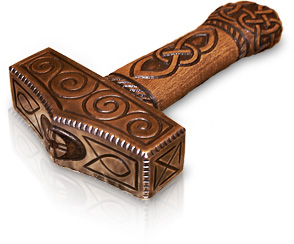
  • Magni – Son of Thor and the giantess Jarnsaxa. Will inherit Thor’s hammer Mjollnir with his brother Modi after Ragnarok.
  • Mimir – Wise Aesir god. Sent to the Vanir to seal the truce between the two groups of the Norse gods. Killed by the Vanir, his head is kept by Odin.
  • Modgud – Maiden guardian of the bridge over the river Gjoll in Jotenheim.
  • Modi – Son of Thor and the giantess Jarnsaxa. Will inherit Thor’s hammer Mjollnir with his brother Magni after Ragnarok.
  • Moon – Son of Mundilfari. Guides the moon on it’s course.
  • Nanna – Wife of Balder and daughter of Nep.
  • Narvi – Also known as Nari. Son of Loki and Sigyn who was killed by his brother Vali.
  • Night – Daughter of Narvi and mother of Day. Rides around the earth on her horse Hrimfaxi.
  • Njord – A Vanir god associated with wind and sea. Husband of Skadi and father of Freyja and Freyr.
  • Norns – Urd “fate”, Skuld “being” and Verandi “necessity”. Three goddesses of destiny.
  • Od – Missing husband of Freyja who she constantly mourns for.
  • Odin – King of the Norse Gods, God of poetry, battle and death. Chief god of the Aesir. Also known as the “all-father”, the “terrible one”, “one-eyed” and “father of battle”.
  • Ran – Wife of Aegir who dragged drowning men down with her net.
  • Rig – Pseudonym of Heimdall and the creator of three races of men.
  • Rind – Goddess and lover of Odin. Mother of Vali.
  • Saga – Goddess and drinking companion of Odin.
  • Sif – Wife of Thor whose golden hair was cut off by Loki.
  • Sigyn – Wife of Loki.
  • Sjofn – Goddess of human passion.
  • Skadi – Goddess of Winter and of the Hunt
  • Sun – Daughter of Mundilfari and guide of the sun.
  • Syn – Goddess of the accused at trial.
  • Thor – God of Sky, thunder and fertility. Associated with law and order in Asgard and guardian of the Norse gods. Son of Odin and Earth and husband of Sif. Also known as the “thunder god” and “charioteer”.
  • Thrud – Daughter of Thor. Promised to the dwarf Alvis.
  • Tyr – War god. Son of Odin who sacrificed his hand in the binding of Fenrir.
  • Ull – God of archery and skiing.
  • Vali – Son of Odin and the giantess Rind. Conceived to avenge the death of Balder.
  • Valkyries – Beautiful women who carried dying warriors to Valhalla.
  • Vanir – Fertility gods.
  • Var – Goddess of marriage oaths.
  • Ve – Son of Bor and brother of Odin and Vili.
  • Vidar – Son of Odin and the giantess Grid who will avenge Odin’s death after Ragnarok.
  • Vili – Son of Bor and brother of Odin and Ve.
  • Vor – Goddess who knows all.

Mythological Realms of The Norse Gods

  • Alfheim – The land of the light elves in Asgard
  • Algron – Island where Odin (Harbard) stayed for five years
  • Asgard – Land of the Aesir
  • Bilskirnir – Thor’s hall in Asgard
  • Bifrost - The flaming rainbow bridge between Asgard and Midgard
  • Breidablik – Balder’s hall in Asgard
  • Elivagar – The eleven rivers that flow from the spring of Hvergelmir in Niflheim.
  • Eljudnir – Hel’s hall in Nifleheim
  • Fensalir – Frigg’s hall in Asgard
  • Folkvang – Site of Freyja’s hall in Asgard
  • Franang’s Falls – Waterfall in Midgard where Loki, disguised as a salmon, was caught by the gods.
  • Gimli – Hall of the gods after Ragnarok
  • Ginnungagap – The void between Muspell and Nifleheim before the creation.
  • Gladsheim – Sanctuary of the Norse gods on the plain of Ida.
  • Glitnir – Silver and gold hall of Forseti, son of Balder, in Asgard.
  • Gnipahellir – Cave in front of Niflheim where the hound Garm is chained up.
  • Helheim – The realm of the dead in Niflheim, ruled over by the monster Hel.
  • Himinbjorg – Heimdall’s hall in Asgard
  • Hlesey – Island near the undersea hall of Aegir and Ran.
  • Hlidskjalf – Odin’s high thrown in Valaskjalf.
  • Hnitbjorg – Stronghold of the giant Suttung.
  • Hvergelmir – Spring in Niflheim under the root of Yggdrasill.
  • Idavoll – The central plain of Asgard. Contains the halls of Gladsheim and Vingolf.
  • Iving – River dividing Asgard from Jotunheim
  • Jotunheim – Land of the giants
  • Lyfjaberg – Mountain beside Menglad’s hall in Jotunheim.
  • Lyngvi – Island on lake Armsvartnir where Fenrir is bound.
  • Lyr – Menglad’s hall in Jotunheim
  • Midgard – The realm of mankind.
  • Mimir’s Well – Well of wisdom under the root of Yggdrasill in Asgard which is guarded by the head of Mimir.
  • Muspell – Southern land of fire guarded by the giant Surt.
  • Nastrond – Site of the hall of evil-does in Hel. The dragon Nidhogg gnaws at corpses here.
  • Niflheim – Land of freezing mist and darkness and home of Hel.
  • Okolnir – Land of warmth created after Ragnarok. Site of the hall of Brimnir.
  • Sessrumnir – Freyja’s hall in Asgard.
  • Sindri – Red gold roofed hall which will appear after Ragnarok.
  • Sokkvabekk – Saga’s hall in Asgard
  • Svartalfheim – Realm of the dark elves.
  • Thrudheim – Thor’s realm in Asgard and site of his hall Bilskirnir.
  • Thrymheim – Stronghold of the giant Thiazi which was passed on to his daughter Skadi.
  • Utgard – Realm in Jotunheim ruled by Utgard-Loki.
  • Valaskjalf – Odin’s hall in Asgard.
  • Valhalla – Hall presided over by Odin where the Einherjar await Ragnarok.
  • Vanaheim – Land of the Vanir in Asgard.
  • Vigrid – Plain in Asgard where the final battle will occur.
  • Vingolf – Hall of the goddesses in Asgard.
  • Ydalir – Ull’s hall in Asgard.
  • Yggdrasill – The world tree (Hodmimir’s wood)

Many believe the Norse gods and the other mythological beings of ancient Scandanavia represent aspects of the self, our emotions and the many qualities that make up the psyche of the human self.

Tags: ,

The Nine Worlds of Norse mythology

The nine worlds.

  • The first level: Asgard, world of the Aesir; Vanaheim, land of the Vanir; and Alfheim, land of the light elves.
  • The second level: Midgard, Land of humans (middle world/garden); Nidavellir, Land of the dwarfs; Jotunheim, Land of the giants (Jotuns); and Svartalfheim, Land of the dark elves.
  • The third level: Hel, Realm of the dead; and Niflheim, World of the dead.

If Hel and Niflheim comprised one world, as is suggested in some sources, the ninth may have been Muspelheim (Muspell), the land of the fire giants. This region had no place in the tricentric structure of the universe, and Snorri Sturluson wrote that is was the first world to exist and that is lies in the southern hemisphere. Also, the worlds of Svartalfheim and Nidavellir may have been the same. No valid distinction can be drawn between the dwarfs and dark elves; they appear to have been interchangeable.

view the original article by Micha F. Lindemans at the Encyclopedia Mythica™

http://www.pantheon.org/articles/n/nine_worlds.html

Tags: , ,

Norse Mythology: A Brief Synopsis

According to Norse mythology, the beginning of life was fire and ice, with the existence of only two worlds: Muspelheim and Niflheim. When the warm air of Muspelheim hit the cold ice of Niflheim, the jötunn Ymir and the icy cow Audhumla were created. Ymir’s foot bred a son and a man and a woman emerged from his armpits, making Ymir the progenitor of the Jotun. Whilst Ymir slept, the intense heat from Muspelheim made him sweat, and he sweated out Surtr, a jötunn of fire. Later Ymir woke and drank Audhumbla’s milk. Whilst he drank, the cow Audhumbla licked on a salt stone. On the first day after this a man’s hair appeared on the stone, on the second day a head and on the third day an entire man emerged from the stone. His name was Búri and with an unknown jötunn female he fathered Bor, the father of the three gods Odin, Vili and Ve.

When the gods felt strong enough they killed Ymir. His blood flooded the world and drowned all of the jötunn, except two. But jötnar grew again in numbers and soon there were as many as before Ymir’s death. Then the gods created seven more worlds using Ymir’s flesh for dirt, his blood for the Oceans, rivers and lakes, his bones for stone, his brain as the clouds, his skull for the heaven. Sparks from Muspelheim flew up and became stars.

One day when the gods were walking they found two tree trunks. They transformed them into the shape of humans. Odin gave them life, Vili gave them mind and Ve gave them the ability to hear, see, and speak. The gods named them Ask and Embla and built the kingdom of Middle-earth for them; and, to keep out the jötnar, the gods placed a gigantic fence made of Ymir’s eyelashes around Middle-earth.

The völva goes on to describe Yggdrasil and three norns, Urðr (Wyrd), Verðandi and Skuld. She then describes the war between the Æsir and Vanir and the murder of Baldr, Odin’s handsome son whom everyone but Loki loved. (The story is that everything in existence promised not to hurt him except mistletoe. Taking advantage of this weakness, Loki made a projectile of mistletoe and tricked Höðr, Odin’s blind son and Baldr’s brother, into using it to kill Baldr. Hel said she would revive him if everyone in the nine worlds wept. A female jötunn – Thokk, who may have been Loki in shape-shifted form – did not weep.) After that she turns her attention to the future.

Ragnarök

Ragnarök refers to a series of major events, including a great battle foretold to ultimately result in the death of a number of major figures (including the gods Odin, Thor, Freya, Heimdall, and the jötunn Loki), the occurrence of various natural disasters, and the subsequent submersion of the world in water. Afterwards, the world resurfaces anew and fertile, the surviving gods meet, and the world is repopulated by two human survivors.

Tags: ,

The Origins of the Norse Mythology

Norse mythology comprises the indigenous pre-Christian religion, beliefs and legends of the Scandinavian peoples, including those who settled on Iceland, where most of the written sources for Norse mythology were assembled.

Norse mythology is the best-preserved version of the older common Germanic paganism, which also includes the very closely related Anglo-Saxon mythology.

The Norse Gods are the mythological characters from stories shared by Northern Germanic tribes of the 9th century AD. These stories were passed down in the form of poetry until the 11th – 18th centuries when the Eddas and other medieval texts were written.

The Poetic Edda (also known as the Elder Edda) was committed to writing about 50 years after the Prose Edda. It contains 29 long poems, of which 11 deal with the Germanic deities, the rest with legendary heroes like Sigurd the Volsung (the Siegfried of the German version Nibelungenlied). Although scholars think it was transcribed later than the other Edda, the language and poetic forms involved in the tales appear to have been composed centuries earlier than their transcription.

Besides these sources, there are surviving legends in Scandinavian folklore. Some of these can be corroborated with legends appearing in other Germanic literatures e.g. the tale related in the Anglo-Saxon Battle of Finnsburgh and the many allusions to mythological tales in Deor. When several partial references and tellings survive, scholars can deduce the underlying tale. Additionally, there are hundreds of place names in Scandinavia named after the gods.

A few runic inscriptions, such as the Rök Runestone and the Kvinneby amulet, make references to the mythology. There are also several runestones and image stones that depict scenes from Norse mythology, such as Thor’s fishing trip, scenes depicting Sigurd (Sigfried) the dragon slayer, Odin and Sleipnir, Odin being devoured by Fenrir, and one of the surviving stones from the Hunnestad Monument appears to show Hyrrokkin riding to Baldr’s funeral.

In Denmark, one image stone depicts Loki with curled dandy-like mustaches and lips that are sewn together and the British Gosforth cross shows several mythological images. There are also smaller images, such as figurines depicting the god Odin (with one eye), Thor (with his hammer) and Freyr (with his enormous phallus).

Tags: , , , , ,

Gefion

Gefion (“giver”) is an old-Scandinavian vegetation and fertility goddess, especially connected with the plough. She was considered the patron of virgins and the bringer of good luck and prosperity. Every girl who dies a virgin will become Gefion’s servant. She is married to King Skjold or Scyld a son of Odin, and lived in Leire, Denmark, where she had a sanctuary. The Swedish kings are supposed to be her descendants.

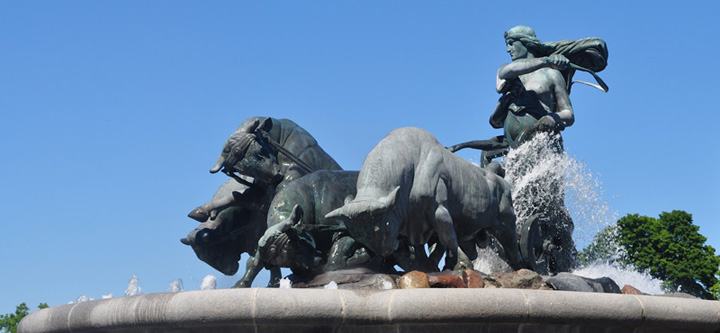
It is traditionally claimed that Gefion created the island of Zealand (“Sjaelland” in Danish) by ploughing the soil out of the central Swedish region with the help of her sons (four Swedish oxen), creating the great Swedish lakes in the process. In Copenhagen, Denmark, there is a large fountain showing Gefion in the process of ploughing.

Gefion could be another form of Frigga who is also known under that name.

view the original article by Micha F. Lindemans at the Encyclopedia Mythica™

http://www.pantheon.org/articles/g/gefion.html

Tags: , ,

Forseti

In Norse mythology, Forseti is the god of justice. He is the son of the god Balder and his mother is Nanna. Forseti rules in the beautiful palace Glitnir, which serves as a court of justice and where all legal disputes are settled. Glitnir has a roof of silver that is supported by pillars of red gold.

Forseti can be compared with the Teutonic god Fosite, who was worshipped on Helgoland.

view the original article by Micha F. Lindemans at the Encyclopedia Mythica™

http://www.pantheon.org/articles/f/forseti.html

Tags: ,

Brunhilde

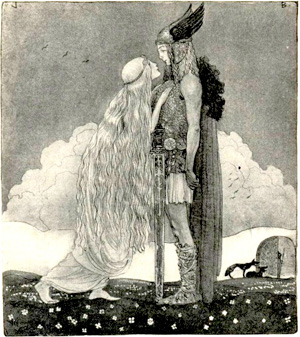
Brunhilde was a mighty female warrior, one of the Valkyries, and a heroine from the German epics, especially in the Nibelungen saga, in which she is a Icelandic princess. She defied Odin and in punishment he imprisoned her within a ring of fire on earth, decreeing that there she would remain until a brave hero rescued her. Siegfied (Sigurd) braved the fire, broke her charmed sleep, and fell in love with her. He gave her the ring, Andvarinaut, unaware of its curse. Eventually she kills herself when she learns that Sigurd had betrayed her with another woman (Gudrun), not knowing he had been bewitched into doing so by Grimhild.

view the original article by Micha F. Lindemans at the Encyclopedia Mythica™

http://www.pantheon.org/articles/b/brunhilde.html

Tags: ,

Buri

Buri is the primeval man in Norse mythology. He had neither father nor mother, but was created by a cow named Audhumla. As she licked the salt blocks of Ginnagagap, the shape of a man — Buri — was formed. Buri had a son named Bor. Bor had three sons who were gods: Odin, Vili, and Ve.

view the original article by Micha F. Lindemans at the Encyclopedia Mythica™

http://www.pantheon.org/articles/b/buri.html

Tags: ,